
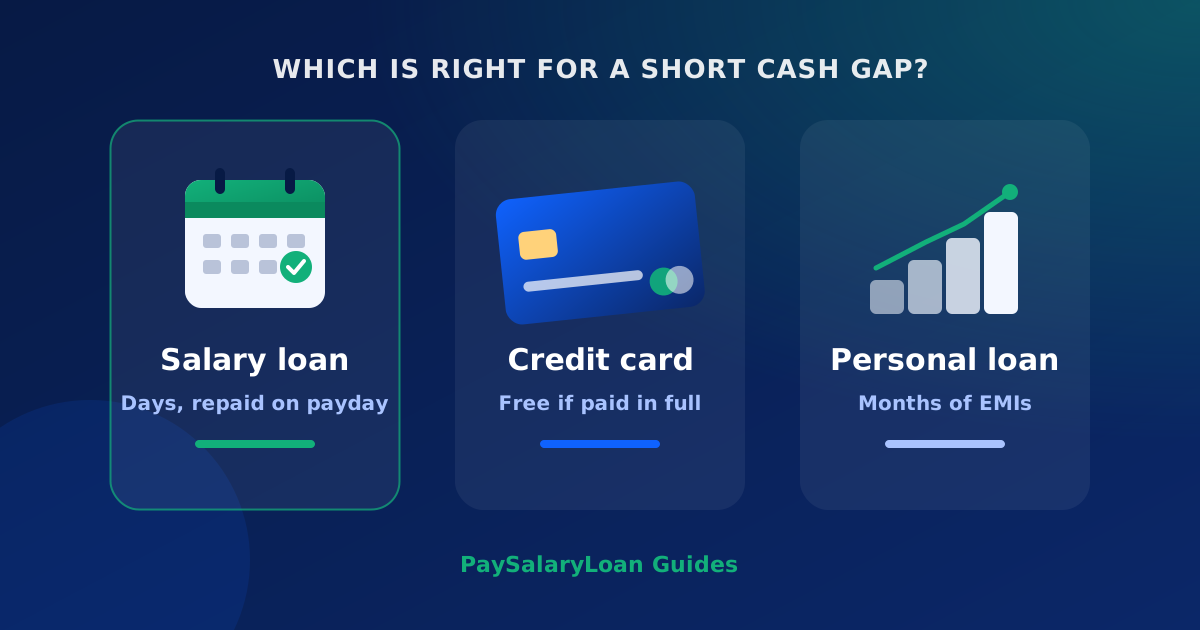
Your rent is due on the 25th, a family wedding needs a gift, or the car needs a repair, and salary arrives on the 1st. Most salaried people in India reach for one of three options to cover a gap like this: a credit card, a personal loan from a bank or NBFC, or a short-term salary loan. Each one is the right answer in some situations and an expensive mistake in others. This guide explains when each makes sense, what a ₹20,000 need for 30 days really costs, and how to choose.
The three options in one line each
- Credit card: a revolving limit you can spend now and repay when the bill comes. Cheap if you clear the full bill on time, costly if you don't.
- Personal loan: a lump sum repaid in fixed monthly EMIs, usually over 12 to 60 months. Built for bigger, planned expenses.
- Salary loan (salary advance): a small, short loan, here ₹8,000 to ₹75,000 for 7 to 40 days, repaid in one go from your next salary.
When each one makes sense
A credit card makes sense when…
You already have a card with enough limit, the expense can be paid by card (or UPI on a card), and you are sure you can pay the full statement amount by the due date. Used this way, a card is often the cheapest short-term credit there is, because purchases usually enjoy an interest-free period until the due date.
A personal loan makes sense when…
The need is large (a medical procedure, a home repair, consolidating expensive debt) and you need several months, not weeks, to repay it. Spreading the cost into EMIs keeps each month manageable. Many lenders also have a minimum loan size well above a typical month-end gap.
A salary loan makes sense when…
The gap is short and the amount is small enough that your next salary can repay it along with your normal monthly expenses. You don't have a credit card, your card limit is used up, or the payment can't be made by card (school fees, rent to a landlord, a cash deposit). You want the money in your bank account quickly and want to be debt-free again within weeks.
Cost comparison: ₹20,000 for 30 days
Here is what the same need can cost on each route. The salary loan figures are our own published example. The credit card and personal loan figures are typical market ranges, not a quote from any lender; your own card or loan terms decide your real cost.
| Credit card | Personal loan | Salary loan (PaySalaryLoan) | |
|---|---|---|---|
| How it is priced | Interest-free until the due date if the full bill is paid; otherwise revolving interest, typically about 3% to 3.75% a month, plus GST on interest | Yearly interest rate on a reducing balance, plus a processing fee (typically 1% to 3% of the loan) and GST | 1% interest per day, plus a 10% processing fee and 18% GST on the fee |
| Cost if repaid as planned | ₹0 interest when the full bill is cleared within the interest-free period | A month of interest plus the processing fee, but you are usually locked into 12 months or more, so you keep paying interest and EMIs well beyond 30 days | Interest ₹6,000 + fee ₹2,000 + GST ₹360 = ₹8,360 |
| Cost if you only pay part | Roughly ₹600 to ₹750 interest a month on ₹20,000 at those typical rates, plus GST, and new purchases can lose their interest-free period until the balance is cleared | EMIs continue as scheduled; missed EMIs attract late charges | Late charges and penal interest apply as shown in your Key Fact Statement (KFS); rolling a short loan over repeatedly is expensive |
| Money in hand | The full amount you spend | Loan amount minus the processing fee and GST | ₹17,640 (the fee and GST are deducted upfront) |
| You repay | The bill amount, plus interest if you revolve | 12 to 60 monthly EMIs | ₹26,000 in one payment on day 30 |
| APR shown upfront | Shown in your card's terms | Shown in the KFS | 576.61% in the KFS before you sign |
Two things stand out. First, a credit card paid in full is hard to beat on cost; if that is genuinely your situation, use it. Second, the short loan's APR looks very high because a one-time fee and 30 days of interest are annualised; our guide on what APR means for short-term loans explains why. What matters for a short gap is the rupee cost and the date you are debt-free.
Why a personal loan is usually overkill for a short gap
A personal loan is designed for 12 to 60 months. Using one to cover a 30-day shortfall means paying a processing fee on a loan you don't need for long, then either paying EMIs for a year or paying it off early. Many lenders also charge a foreclosure fee if you close it early, and some won't lend amounts as small as ₹20,000 at all. Read salary advance or EMI loan for a quick way to decide between those two.
Speed and documents
- Credit card: instant if you already hold one. Applying for a new card can take days to weeks, with income proof and a credit check, and the limit may be lower than you need.
- Personal loan: pre-approved offers can be quick, but a fresh application often takes hours to days, with salary slips, bank statements, KYC and sometimes employer verification.
- Salary loan: a fully online application with a decision in ~10 min. You need a PAN, an Aadhaar-linked mobile for eKYC, three months' salary statement and a live selfie. You need to be 21 to 55 years old with a net salary of at least ₹30,000 a month credited to your bank account.
Risks to watch
- The minimum-due trap: paying only the minimum on a credit card keeps the balance revolving at high monthly interest. Pay the full amount, or as much as you can.
- Cash withdrawals on a card: these usually carry a fee and interest from day one, with no interest-free period.
- Borrowing longer than you need: a five-year personal loan for a one-month problem means years of EMIs and more total interest.
- Rolling over short loans: if your next salary can't repay a salary loan in full, don't take another one to pay it off. Talk to the lender early instead.
- Late payments: any of the three can hurt your credit score if you pay late. Repaying on time can help build it.
- Fake lenders: never pay an upfront fee or share an OTP over a call. Check the lender is RBI-registered; see 7 signs of a fake loan app.
How to choose
- Do you have a credit card with enough limit, can you pay by card, and can you clear the full bill by the due date? Use the card.
- Is the need large, or will it take more than one or two salaries to repay? Choose a personal loan with EMIs you can afford.
- Is it a short gap that your next salary can comfortably cover, and you need cash in your bank account? A salary loan fits. Check the exact rupee cost first in the loan calculator.
- Whichever you choose, borrow only what you need and read the Key Fact Statement before you accept.
Frequently asked questions
Is a salary loan cheaper than a credit card?
Not if you pay your card bill in full within the interest-free period; then the card costs nothing. A salary loan helps when you can't use a card, have no limit left, or need money in your bank account.
Can I repay a salary loan early?
Yes. There is a ₹0 prepayment charge, and interest is charged only for the days you keep the money, so repaying early lowers your cost. You can also cancel within the 3-day cooling-off period by repaying the principal and proportionate interest, with no penalty.
Will checking my offer affect my credit score?
Checking your offer with us does not affect your credit score. Missing a repayment on any loan or card can.
Who is the lender?
Loans on PaySalaryLoan are given by Salora Capital Limited, an RBI-registered NBFC. PaySalaryLoan is operated by New Age Business Solutions Private Limited, its lending service provider.
Disclaimer
This article is general information, not financial advice. Credit card and personal loan figures are typical market ranges shown for illustration and are not offers or quotes from any lender. Our own figures are a representative example; your actual rate, fees, APR and repayment are shown in your Key Fact Statement before you accept. Borrow only what you can repay on time.